
Bruce Springsteen and cinema
CRITICAL NOTES
The relationship between the American rocker and film (as he makes an “appearance” in Venice)
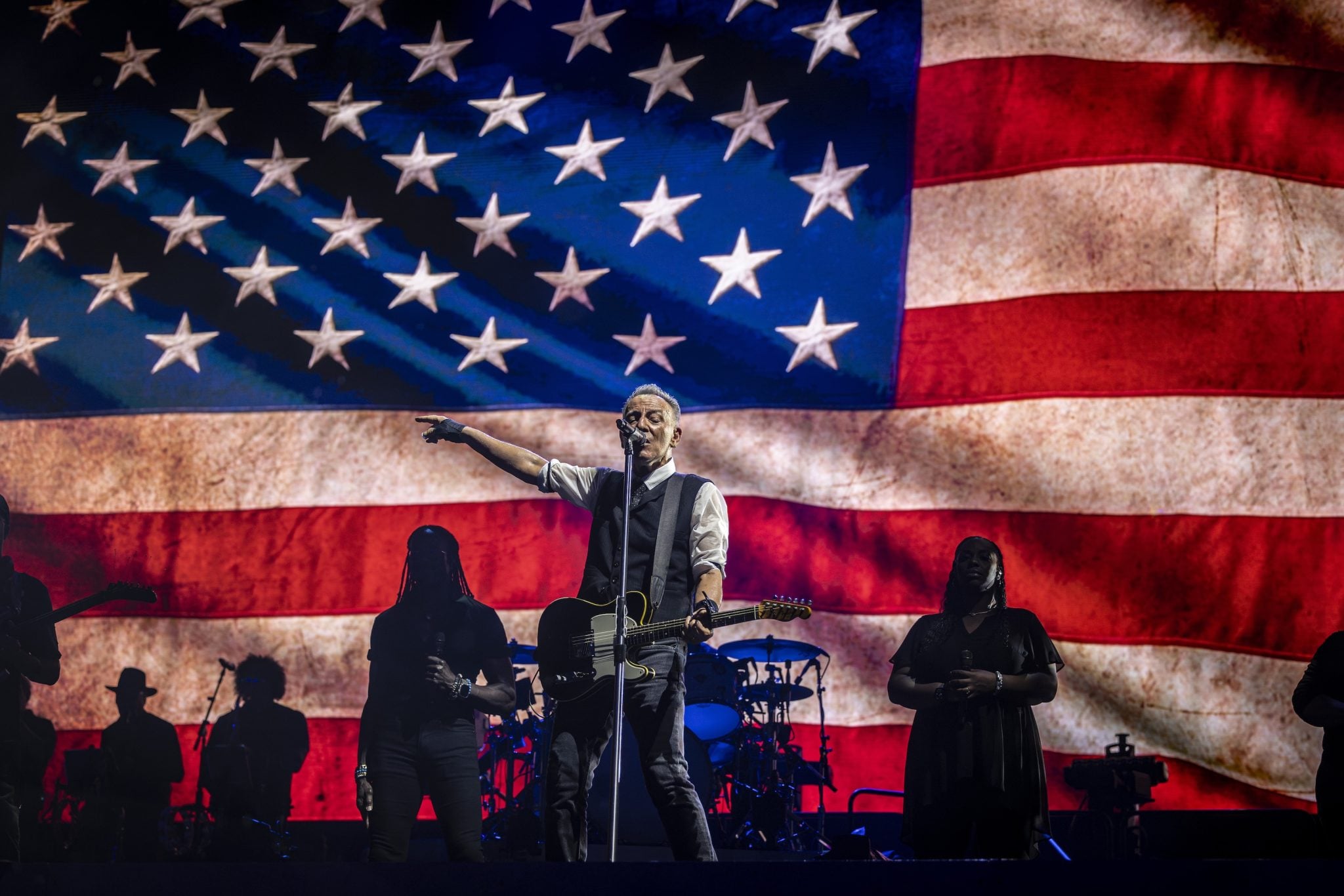
As a devoted and loyal Springsteen fan, among the news items that most intrigued and interested me during the Venice International Film Festival, which wrapped up on Saturday evening at the Lido, one that certainly stands out concerns Bruce Springsteen’s appearance in Nanni Moretti’s new film, Succederà questa notte. Incidentally, the film was completely overlooked by the jury led by Maggie Gyllenhaal, which, during yesterday’s ceremony, awarded the 2026 Golden Lion to Woman Unknown by Danish director Mayy al-Tukhi.
I haven’t yet had the chance to see Moretti’s film, but reports from Venice reveal that it features a significant sequence, starring Louis Garrel and Hippolyte Girardot, set during the Springsteen’s concert of June 21, 2025 in Spain, at the Estadio Reale Arena in San Sebastián, in the Basque Country. This was a European leg of the successful tour the American rocker undertook last year on both sides of the Atlantic; a tour that, in recent months (between late March and late May), saw an even more “political” revival with new US dates for the controversial yet magnificent Land of Hope and Dreams American Tour (pictured here). Notably, that tour also saw the online release on September 9 of a forty minutes video featuring the first excerpt from the concert film focusing on the moving closing performed on the night of May 30 in Philadelphia (viewable here).
Returning to Moretti’s film, the scene shot during the concert captures Garrel and Girardot while Springsteen and the E Street Band perform some of the great classics from their repertoire, such as Because the Night and Hungry Heart. During the film’s press conference, producer Domenico Procacci described the complexity of the undertaking: «It was difficult and time-consuming. It involved a very close relationship with Claudio Trotta, who organized all of Bruce Springsteen’s concerts in Italy and had a long-standing connection with him. It was a lengthy, difficult, and costly process. Furthermore, we had to deal with limitations regarding the use of the songs and footage». For his part, Nanni Moretti added a comment that was both serious and ironic: «My personal record, the one I set with the money spent on Keith Jarrett’s The Köln Concert in Caro diario, has been shattered».
It is worth noting, among other things, that Springsteen’s music had already appeared in Moretti’s filmography in the past; in 1989, the Roman director used I’m on Fire as the soundtrack for the famous water polo match sequence in Palombella Rossa. In the new film Succederà questa notte, set for release in Italian cinemas on December 3rd, alongside two live performances of Springsteen hits, the Rolling Stones’ She’s a Rainbow will also feature, further confirming Moretti’s love for great music, including pop-rock.
This inclusion in Nanni Moretti’s new film serves as yet another demonstration of the close and profound bond between Bruce Springsteen and cinema, an affinity that extends beyond the American film industry. Back in 2012, I dedicated a book to this subject, a topic that had barely been critically explored at the time, titled Il cinema secondo Springsteen (“Cinema According to Springsteen”), published by Mephite–Cinemasud and co-edited by myself and Vincenzo Esposito. Although the volume has long been out of print, it contained ideas that I have since had the opportunity to develop further elsewhere. The New Jersey-born artist’s relationship with the seventh art is truly unique on a global scale. In our book, Esposito and I emphasized that this connection could not be reduced merely to the use of Springsteen’s songs in soundtracks, his various film appearances, or documentaries dedicated to him, as is often the case with other giants like Elvis, the Beatles, the Rolling Stones, or Dylan. His case is different, arguably unique, characterized by a deeply empathetic relationship with film that has evolved across two distinct phases of a career spanning more than fifty years.
During the first phase of his career, spanning from his 1973 debut album Greetings from Asbury Park, N.J. to the global success of Born in the U.S.A. in 1984, Springsteen looked to film as a primary source of inspiration for his visual, narrative songwriting and for the creation of characters and situations. In doing so, he absorbed a significant portion of American cinema’s cultural heritage into his developing artistic vision: ranging from Arthur Ripley’s 1958 B-movie Thunder Road (starring Robert Mitchum) to quintessential American classics like Laszlo Benedek’s The Wild One (1954), Nicholas Ray’s Rebel Without a Cause (1955), and Elia Kazan’s East of Eden (1955); as well as Monte Hellman’s Two-Lane Blacktop (1971) and John Ford’s masterpieces The Grapes of Wrath (1940) and The Searchers (1956). Crucially, he also experienced a formative cinematic encounter with Terrence Malick’s Badlands (1973); from this film, he drew the sense of dislocation experienced by the narrator in the title track that opens Darkness on the Edge of Town, and to which he returned four years later while composing the somber Nebraska, an album whose title track begins with lines that faithfully quote the opening sequence of the film starring Martin Sheen and Sissy Spacek. Incidentally, the creative process behind this pivotal album in Springsteen’s body of work was brilliantly chronicled last year by director Scott Cooper in that great American classic film, albeit one that was unfortunately underrated and misunderstood, Deliver Me from Nowhere. It is a work of immense narrative and emotional depth that reconstructs the genesis of Nebraska and its creator’s descent into depression, drawing on Warren Zanes magnificent book of the same name as well as passages from the bestselling autobiography Born to Run.
However, starting in the early 1990s, as previously noted, his relationship with film became even more fascinating; Springsteen continued to “take” from cinema in search of inspiration – now with the added benefit of a more structured cultural background than in his youth – but simultaneously began to “give”, eventually becoming (often beyond his own intentions) a touchstone for American cinema and culture. Consequently, Hollywood began to focus intently on a narrative universe that possessed internal coherence and recurring themes, a world rich in ideas and evocative imagery, perfect for inspiring hit movies or sparking intriguing artistic intersections. Indeed, from the mid-1990s onwards, numerous filmmakers turned their attention to the increasingly powerful and distinct “Springsteenian imagery”, that wandering journey through the folds and behind the scenes of the American Dream, seeking what the Myth seeks to conceal, right where the “darkness on the edge of town” feels most intense and oppressive. Examples range from Michael Apted (Thunderheart, 1992) and Robert Altman (the Carver-esque Short Cuts, 1993), to the Coen brothers (Fargo, 1995; No Country for Old Men, 2007) and Gus Van Sant (To Die For, 1995; Good Will Hunting, 1997; Promised Land, 2012). In many cases, the inspiration lies in the settings; in others, it stems from tormented characters grappling with the “heart of darkness” of a nation they themselves struggle to recognize – amidst new forms of poverty, factory closures, and depopulating regions – in that vast “outskirts of the soul” that Springsteen had so powerfully chronicled years earlier on albums that have since become classics as Darkness on the Edge of Town (1978), The River (1980), Nebraska (1982), and Born in the U.S.A. (1984); themes he would revisit in The Ghost of Tom Joad (1995), Devils & Dust (2005), and Wrecking Ball (2012). This confirms that the American rocker’s “political” engagement did not originate – as detractors or the inattentive might like to think – with the recent Streets of Minneapolis or his outspoken anti-Trump stances of recent years.
As early as the last decade of the twentieth century, his figure assumed an increasingly central role in the American socio-cultural landscape, making him a genuine touchstone for the cinema of that era as well. In 1991, the song Highway Patrolman (featured on the Nebraska album) actually inspired the plot of an entire film, as acknowledged in the credits: Sean Penn’s directorial debut, The Indian Runner, an intense, biblically resonant drama about the troubled relationship between two rival brothers, played by David Morse and Viggo Mortensen. The connection was fully established, and from that moment on, the “Springsteen Universe” was – and continues to be – regularly mined by American cinema.
A particularly interesting case – and it is no coincidence that I devoted considerable space to it in the aforementioned book – is Cop Land (1997). Directed by James Mangold and set in the fictional New Jersey town of Garrison, the film was crafted using characters, atmospheres, situations, settings, and evocative elements drawn from Bruce Springsteen’s first seven albums. «In fact, had the title not already been used for the record, the director – I wrote at the time – could legitimately have named his film Darkness on the Edge of Town, confident that he had chosen a title capable of capturing its deepest essence». In Garrison and its surroundings, the heavy-set Sheriff Freddy Heflin, played by Sylvester Stallone, is immersed in a world of broken promises, secret debts that eventually come due, used or stolen cars, night drives to the nearby Big Apple, hillside mansions, soul-crushing abandoned factories, local heroes, girls waiting on suburban porches, restless night owls, slamming screen doors, young suburban toughs, pinball machines and jukeboxes, trysts across the river, cops both good and bad, dreamers and the disillusioned. The “signature” on this familiar landscape comes in the form of two Springsteen tracks included on the soundtrack: Stolen Car and Drive All Night, twin songs from The River centered on failed romances, late-night drives, and souls tormented by regret and remorse.
In my view, a film like Cop Land vividly demonstrates the central importance of the Springsteenian ethos within the broader context of American popular culture: having drawn heavily on cinema for his songs, Bruce Springsteen, at this stage of his artistic journey, possesses the stature to serve as a definitive touchstone for Hollywood (and beyond) as it approaches the new millennium. This is further confirmed by another significant film, Darren Aronofsky’s The Wrestler (2008), featuring a remarkable Mickey Rourke as Randy “The Ram”, a former 1980s wrestling star. Twenty years later, he is a broken man, physically and spiritually battered and overweight, forced to fight in cheap, low-stakes matches held in the gritty world of suburban gyms. Set in a New Jersey that seems lifted straight out of Darkness on the Edge of Town or The River, the film was driven largely by Rourke himself; at the time, he was eager to use metaphor to dramatize his own life story and stake everything on a deeply personal role that would determine whether he faced total ruin or a major comeback. It was the actor, a fellow New Jerseyan and friend of Springsteen, who asked him for a song for the soundtrack. The track, also titled The Wrestler, was provided free of charge; it is a magnificent acoustic composition for guitar and piano that, according to director Aronofsky, «perfectly captures the spirit of the film and the essence of Mickey’s character», a quintessential Springsteenian working-class figure swept aside by the dark side of the American Dream. He is a sort of veteran of an unfought war, wounded internally by Reaganomics and economic crisis, yet still ready to fight to reclaim that increasingly elusive dream. The iconic setting for one of the film’s most poetic and poignant sequences also evokes the universe of Springsteen’s songs: the unmistakable Asbury Park boardwalk, featured in many of the singer’s hits, where the washed-up wrestler confesses his weaknesses to his beloved daughter during a walk that turns into a reckoning with the unraveling of the American Dream.
In recent years, to conclude without further ado, borderline cases like Cop Land or The Wrestler have been followed by projects that are culturally even more compelling, such as Blinded by the Light (2019), directed by Gurinder Chadha. From the opening sequence to the last, the film is constructed as a veritable “emotional anthology” of Springsteen’s music; it features numerous songs – staged almost like a rock musical – but, above all, it incorporates a myriad of visual-narrative elements and historical-cultural references that even moderately informed viewers, or devoted fans, now pick up almost automatically, simply because these elements have long been part of their (and our) own shared cultural imagination.


